


Footcandles and lux are essential metrics for measuring illumination. Footcandles, commonly used in the U.S., provide a straightforward method for evaluating light intensity on surfaces, while lux is the metric alternative. Consistent standards enhance lighting effectiveness, ensuring peak performance across various environments. For instance, parking lots require a minimum of 10 fc, while laboratories necessitate 75-100 fc for precision tasks. Choosing the right measurement improves design decisions, guiding users to achieve desired lighting outcomes. Explore how this knowledge can enhance your projects.
Key Takeaways
- Footcandles measure illumination in the U.S., while lux is the metric equivalent, often preferred in international contexts.
- Standardizing lighting design using either footcandles or lux ensures consistency and compliance with industry standards like IES.
- Appropriate footcandle levels vary by application; classrooms need 30-50 fc, while laboratories require up to 100 fc for optimal performance.
- Calculating footcandles can help in selecting lighting fixtures; use the formula FC = Lumens ÷ Area (sq ft) for accurate assessment.
- Utilizing lighting simulation tools like DIALux can optimize light output and ensure the desired illuminance levels across different spaces.
Understanding Footcandles and Lux
Understanding the nuances between footcandles and lux is essential for effective lighting design and application in various environments. Footcandles (fc) quantify illumination at a particular surface point, with one footcandle equating to 10.764 lux. Conversely, lux serves as the metric measure of illuminance, mainly outside the United States. Proper lighting design necessitates awareness of specific illuminance requirements; for instance, a parking lot typically requires about 10 fc, while a tennis court may demand up to 30 fc. Adhering to industry standards, such as those from IES, is critical for achieving recommended footcandle levels for different spaces, ensuring both functionality and comfort. By understanding these measurements, designers can effectively illuminate various environments and meet user needs. Energy-efficient lighting solutions, such as those provided by products like Ensenior LED Recessed Ceiling Lights, can help achieve desired lighting conditions while minimizing power consumption.
The Importance of Consistent Lighting Standards
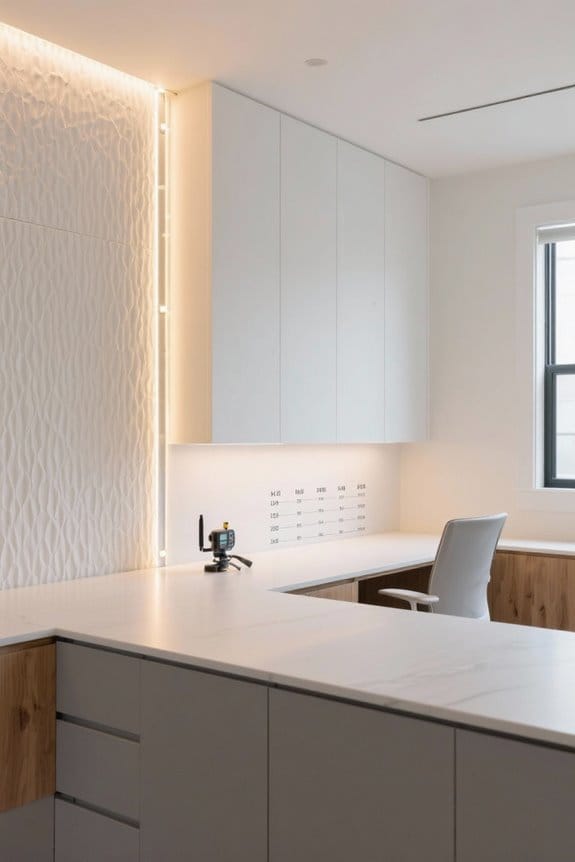
Consistency in lighting standards acts as a cornerstone for effective illumination design, influencing safety, productivity, and visual comfort across various environments. Standards like foot-candles in the U.S. and lux in metric countries guarantee uniform illuminance, vital for spaces such as classrooms and laboratories. The IES outlines recommended foot-candle levels, ranging from 30-50 fc for classrooms to up to 100 fc for laboratory settings. Adhering to these standards prevents issues of under-lighting or over-lighting, enhancing productivity and comfort. Employing a common measurement for lighting fixtures allows for straightforward comparisons, making certain that energy consumption remains efficient while meeting required illumination levels. This shared approach among professionals fosters better-informed decisions in lighting design, ultimately benefiting users and projects alike. Fixtures made from robust metal and glass with anti-rust finishes ensure durability in lighting design, contributing to consistent performance in various environments, including damp spaces.
Calculating Footcandles for Your Space

Calculating the appropriate footcandle levels for a space is a fundamental aspect of effective lighting design. To determine footcandles (fc), one can use the formula: Footcandles = Lumens ÷ Area (in square feet). For instance, if a fixture emits 10,000 lumens across 500 square feet, it yields 20 footcandles. Different environments have specific footcandle requirements; offices generally need 30-50 fc, while task areas may demand 50-100+ fc. Key factors influencing footcandle calculations include the lighting layout, fixture placement, mounting height, beam angle, and the reflectiveness of nearby surfaces. Utilizing lighting simulation tools like DIALux allows designers to optimize light output, ensuring they achieve the desired footcandle levels for any project. Under cabinet lighting is an example where calculating the correct footcandle levels is crucial to achieve the desired ambiance and functionality.
Comparing Footcandles and Lux
While both footcandles and lux measure illumination, each serves distinct purposes in evaluating lighting effectiveness. Footcandles (fc) quantify light at a specific point on a surface, essential for determining usable illumination, such as in office settings needing 30-50 footcandles. Conversely, lux is the metric equivalent, where one footcandle equates to approximately 10.764 lux, translating lighting levels into a universally recognized format. In sports lighting applications, requirements can vary considerably; for example, high school football stadiums often require around 50 footcandles, while Major League Baseball fields may need up to 250 footcandles. Understanding these differences is vital for effective lighting design, ensuring compliance with IES standards and optimizing illumination across diverse environments. LED battery picture lights offer portable and flexible solutions for indoor artwork illumination, which can enhance lighting design in residential and gallery settings.
Recommended Footcandle Levels for Different Applications
Effective lighting is critical across various environments, as each application has specific illuminating needs. For maximum safety in corridors and stairwells, a lighting level of 5-10 footcandles is recommended. Classrooms should achieve 30-50 footcandles to support effective reading and teaching. In commercial and industrial laboratories, higher illumination levels of 75-100 footcandles are crucial for precise tasks and experiments. Parking garages necessitate a minimum of 10-15 footcandles to guarantee visibility for both drivers and pedestrians. For office environments, an average of 40 footcandles is advisable, enhancing productivity and comfort for work activities. Some motion sensor night lights feature dusk-to-dawn sensors that activate at night and deactivate at dawn, ensuring efficient use of energy and optimal lighting conditions in various settings. These specific points emphasize the importance of appropriate lighting levels tailored to each environment’s unique requirements.
Factors Affecting Illumination in Spaces
Illumination in any space is influenced by several vital factors that must be carefully considered to achieve ideal lighting conditions. Footcandles measure light intensity; hence, understanding fixture placement is essential. The mounting height of LED fixtures impacts brightness and coverage, while beam angles determine light concentration; narrow angles focus light, whereas wider angles distribute it more evenly. Additionally, the layout of fixtures is significant for uniform light distribution, reducing shadows and ensuring consistent illumination. Reflective surfaces enhance perceived light levels, amplifying brightness. Environmental factors, including wall and floor colors, also play a role; lighter colors tend to reflect more light, helping meet specific lighting requirements. Some plug-in swing arm lamps offer adjustable arms for customizable lighting positioning and dimmable features for personalized brightness levels. Properly addressing these elements leads to effective lighting solutions for diverse applications.
Cross Over Lighting and Its Benefits
In modern sports lighting design, cross over lighting emerges as a powerful strategy for enhancing visibility and performance on playing fields. This approach utilizes multiple light sources to effectively reduce shadows and bright spots, achieving ideal illumination with a minimum of four lights. Such setups are essential for maintaining consistent lighting, which is vital for player performance and reducing distractions. Additionally, good cross over lighting design minimizes glare, promoting eye comfort and safety for both players and spectators. Incorporating LED technology into these systems further enhances efficiency while maintaining adequate footcandles. To assess glare and backlighting, the BUG rating system serves as a valuable tool for ensuring that new lighting installations meet the desired cross over lighting standards, ultimately elevating the sporting experience. For optimal performance, wet-rated outdoor lights are crucial in ensuring durability and functionality in various weather conditions, enhancing the overall quality of sports lighting.
Using Lumens, Footcandles, and Lux in Lighting Design
Understanding the use of lumens, footcandles, and lux in lighting design is essential for achieving ideal visibility and functionality in various spaces. Lumens measure the total light output from fixtures, facilitating comparisons of brightness among light sources. However, they do not indicate usable light on surfaces. Footcandles quantify illuminance at specific points, with standard levels ranging from 5 footcandles for corridors to 250 footcandles for Major League Baseball fields. Lux, the metric equivalent, simplifies international standards, as 1 footcandle equals approximately 10.764 lux. To calculate footcandles, divide total lumens by the area in square feet. Effective lighting design integrates both footcandles and lux, ensuring compliance with IES standards while enhancing visibility and comfort in diverse environments.
Leveraging Technology for Effective Lighting Solutions
Advancements in technology are reshaping the landscape of lighting design, offering innovative solutions that enhance both efficiency and effectiveness. Utilizing photometric software, like DIALux, allows designers to simulate various lighting scenarios, ensuring ideal footcandles and lux levels across different spaces. Modern LED lighting systems direct lumens efficiently, minimizing the loss of light and improving brightness where it’s most needed. An extensive photometric study is essential for analyzing current illumination, identifying areas for a lighting upgrade, and tailoring solutions to meet specific project requirements. Additionally, leveraging the BUG system (Backlight, Uplight, Glare) mitigates glare and enhances user comfort, making it a crucial tool in evaluating new lighting systems for diverse environments. Many LED recessed downlights, like those offered by Ensenior 12 Pack, provide adjustable color temperatures and dimming options, catering to specific project needs while ensuring energy efficiency.
Frequently Asked Questions
What Is the Difference Between Footcandles and Lux?
In a dimly lit office, footcandles measure brightness at specific locations while lux provides overall illumination levels. Understanding these differences and conversion factors is essential for effective lighting applications and addressing environmental impact.
What Are the Footcandle Standards in Lighting?
Footcandle standards vary by application, with indoor lighting for classrooms averaging 30-50 fc and outdoor lighting for sports fields at 50 fc. Proper lighting design guarantees ideal illumination levels, enhancing lighting ergonomics for safety and effectiveness.
Is 1 Footcandle Approximately Equal to 10 Lux?
Yes, one footcandle approximates ten lux, highlighting the footcandle equivalence comparison. This relationship is essential for lux measurement applications, influencing lighting design considerations and ensuring adherence to international lighting standards in practical lighting calculations.
How Many Foot Candles Equal 1 Lumen?
Like sunlight filtering through trees, one lumen does not equate directly to footcandles; it varies with area. Lumen measurement techniques reveal complexities, while a converting units chart aids practical application examples in lighting intensity comparison, affecting visual perception.


