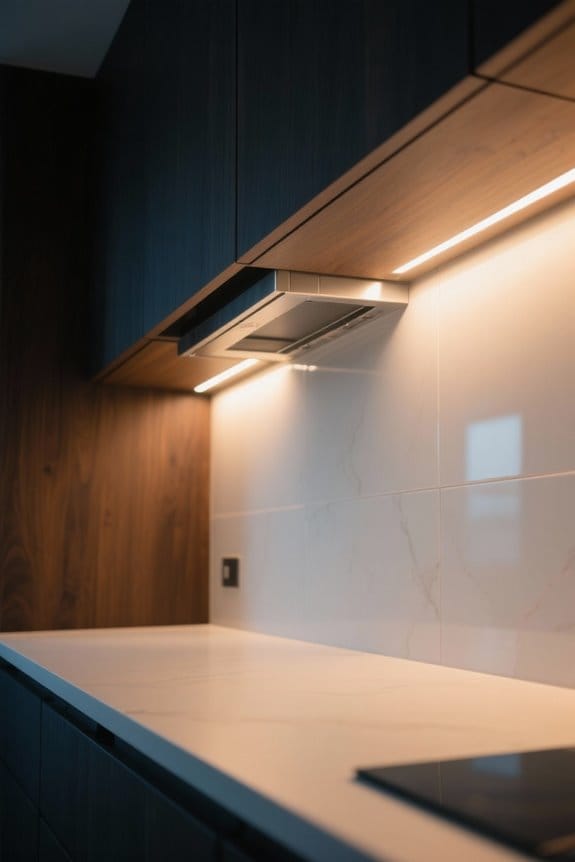


Workbench task lighting is essential for achieving peak visibility and precision during various tasks. Ideal brightness levels range from 1,000 to 2,000 lumens, with color temperatures between 4,000K and 5,000K to enhance focus. A high Color Rendering Index (CRI) above 80 guarantees accurate color perception. Incorporate layered lighting and position fixtures strategically to minimize glare and shadows, using options like LED desk lamps and under-cabinet lights. Exploring different lighting solutions will provide insights into achieving the best workspace illumination.
Key Takeaways
- Ideal brightness for workbench tasks ranges from 1,000 to 2,000 lumens, ensuring sufficient light for various activities.
- Recommended brightness levels are 200 lux for basic tasks and over 800 lumens for detailed work.
- A color temperature between 4,000K and 5,000K optimizes visibility and focus, mimicking natural light.
- Use high CRI bulbs (above 80) for accurate color perception, especially crucial for craftsmanship.
- Proper lamp positioning reduces shadows and glare, enhancing overall safety and efficiency during tasks.
The Importance of Workbench Task Lighting
While effective lighting may often be overlooked, its significance in a workbench setting cannot be understated. Proper workbench task lighting substantially enhances visibility, allowing for precise execution of various work activities. Recommended brightness levels may range from 200 lux for basic assembly tasks to 1000-1500 lux for precision and micro mechanics work. Utilizing lighting with a color temperature between 4000K and 5000K helps promote focus, mimicking natural daylight conditions. Lights with a high Color Rendering Index (CRI) above 80 are essential for accurate color perception in detail-oriented environments. To optimize comfort and productivity, effective lighting setups should ideally combine ambient lighting with focused task lighting, which minimizes shadows and glare, ultimately creating a safer and more efficient workspace. LED lights, known for energy efficiency, are an excellent choice for task lighting due to their high lumen output and long lifespan.
Understanding Brightness in Lumens

Brightness serves as a fundamental pillar in effective workbench task lighting, primarily gauged in lumens. For proper lighting, a range of 1,000 to 2,000 lumens is recommended, ensuring adequate illumination for precision work. Basic assembly requires a minimum of 200 lux, while high-precision tasks, like micro mechanics, necessitate 1,000-1,500 lux. Task lighting should provide about 400 to 600 lumens for reading and over 800 lumens for detailed work, enhancing visibility. Additionally, utilizing high CRI (Color Rendering Index) bulbs, ideally above 80, improves color accuracy, essential for detailed projects. Properly positioning lights to achieve 75-80 foot-candles can notably enhance safety and efficiency, making thoughtful lumens output critical in workshop environments. LED spotlights are energy-efficient options that significantly reduce energy consumption while providing high brightness levels, making them an ideal choice for task lighting.
Ideal Color Temperature for Workbench Lighting

Achieving the ideal color temperature for workbench lighting is vital for enhancing both visibility and focus during detailed tasks. The ideal color temperature typically falls between 4,000K and 5,000K, providing a cool white light that boosts concentration. A color temperature of 4,500K is frequently recommended, as it balances illumination and reduces eye strain, making it perfect for intricate work areas. Additionally, lighting solutions that offer bright light approaching daylight (5,000K-6,500K) can greatly enhance alertness, especially in environments devoid of natural light. However, temperatures above 5,000K may create stress in creative tasks. Selecting focused task lighting with a high Color Rendering Index of 80 or above guarantees accurate color perception, essential for high-quality results in craftsmanship and precision-related activities. Fixtures compatible with various bulb types enable customization of brightness and ambiance in workbench lighting, providing flexibility for different tasks and preferences.
The Role of Color Rendering Index (CRI)
Color Rendering Index, commonly referred to as CRI, plays an essential role in the effectiveness of workbench task lighting. CRI measures how accurately a light source displays colors compared to natural light, with higher values indicating better color rendering. For task lighting, a CRI above 80 is generally recommended, while values of 90 and above are ideal for achieving precision in color-sensitive tasks, such as painting or crafting. Insufficient CRI levels can result in eye strain and fatigue, decreasing productivity within the workspace. Many LED lights are now designed to deliver both high brightness and high CRI, making them a must-have for any detailed work environment. Selecting the right lighting can greatly enhance both comfort and accuracy during various tasks. Some smart color bulbs offer customizable white light, allowing users to tailor their lighting experience for both ambiance and task performance.
Recommended Lumens for Various Tasks
Selecting the appropriate lumens for various tasks is essential for establishing an efficient work environment. For basic assembly work, a lighting level of 200 lux is ideal to avoid eye strain, while medium-precision assembly tasks thrive under lighting conditions of 300 lux. Intricate assembly work requires brighter lighting levels of around 500 lux, enabling better detail recognition. High-precision tasks may necessitate intensities between 750 to 1000 lux, ensuring optimal clarity. For precision and micro mechanics, achieving 1000 to 1500 lux provides the brightness needed for exacting tasks. Utilizing LED task lights can enhance these lighting conditions considerably, making them a must-have for workspace illumination. Many LED magnifying desk lamps feature adjustable brightness settings, allowing users to customize the lighting to suit different preferences and tasks. These recommendations guide workers in creating effective environments tailored to their specific assembly needs.
Types of Lighting Fixtures for Workbenches
When considering effective lighting solutions for workbenches, it is essential to explore various fixture types that enhance visibility and minimize shadows. LED desk lamps are a task-focused must-have, offering adjustable lighting and customizable color temperature for precision work. Under-cabinet lights serve as an excellent option for illuminating countertops, ensuring detailed tasks can be performed effortlessly. Pendant lights can add both function and style, creating a visually appealing workspace while providing ample illumination. Additionally, track lighting systems are beneficial for their flexibility, allowing users to redirect light as needed across different work areas. Each of these lighting solutions contributes to creating an effective work environment, promoting productivity and accuracy during various tasks. Incorporating versatile options like modern LED wall sconces can further enhance the ambiance and functionality of your workspace.
Placement Strategies to Enhance Visibility
To achieve ideal visibility at a workbench, precise placement of task lighting is essential for effective performance. Employ thoughtful placement strategies by situating task lighting to shine from the side or above, thereby minimizing glare and reducing shadow risk on the work surface. It is vital to position lights at an angle that effectively addresses reflections on glossy surfaces, which can distract during detailed tasks. Utilize adjustable lights to guarantee suitable illumination tailored to the user’s dominant hand, facilitating ease of movement. In addition, incorporating multiple light sources around the work area fosters uniform lighting, eliminating dark spots. Positioning lights 16 to 24 inches above the work surface achieves adequate brightness levels, ideally between 750 to 1,500 lux for intricate work. Adjustable LED downlights, which consume only 12 watts, offer energy-efficient lighting solutions while maintaining ample brightness for workbench tasks.
Adjustable Lighting Features for Flexibility
Effective workbench illumination benefits greatly from adjustable lighting features, which offer unprecedented flexibility in how light is distributed. Articulating arms and flexible necks allow users to direct light precisely where it is needed for detailed tasks. Dimmable options enable modification of brightness levels, ranging from 200 to 1500 lux, tailored to various activities from basic assembly to high-precision work. Moreover, LED task lamps equipped with rotating heads provide versatility, minimizing glare and shadows. The integration of smart technology enhances usability by allowing remote control of brightness and color temperature. Additionally, adjustable mounting styles, including clamp-on or wall-mounted fixtures, customize lighting arrangements to meet different workspace designs, ensuring ideal task execution and user comfort. Dimmable LED floor lamps, known for their energy efficiency, save up to 90% on electricity bills, making them a cost-effective and environmentally sustainable lighting solution.
Layering Lighting for Optimal Coverage
Layering lighting in a workspace not only enhances visibility but also fosters a more inviting and efficient environment for productivity. Combining ambient, task, and accent lighting is key to achieving ideal coverage and reducing eye strain. For effective task lighting, a brightness of 400-600 lumens suffices for general tasks, while detailed work may demand over 1,000 lumens to guarantee clarity. Employing a color temperature between 4,000K and 5,000K mimics natural daylight, promoting focus and alertness. Positioning task lights strategically, from the side or above, aids in glare reduction and comfort. Incorporating adjustable lighting features, like dimmable switches or articulating arms, allows users to tailor light intensity and angle, adapting their workspace to specific tasks and personal preferences. To ensure energy efficiency and cost savings, consider using LED retrofits that can save up to 90% on energy costs, as highlighted in the knowledge section.
Avoiding Glare and Shadows
While setting up a well-lit workspace, it is crucial to contemplate glare and shadows, as they can considerably detract from productivity and comfort. To minimize glare, position LED lighting to illuminate tasks from the side or above, avoiding direct light into the worker’s eyes. Selecting high-quality, flicker-free LED lights guarantees uniform illumination, reducing overlapping shadows that contribute to eye strain. An effective strategy involves using adjustable lighting with dimmable features to customize brightness based on specific tasks, managing glare levels effectively. Additionally, maintaining a colour temperature between 4000K and 5000K promotes concentration without harsh glare, offering an ideal balance of illumination that enhances the workspace environment, ultimately supporting productivity and comfort. Using motion sensor lights in workspaces can provide energy-efficient illumination that activates only when needed, thus contributing to a well-managed lighting setup.
Smart Lighting Solutions for Workspaces
Optimizing workspace illumination can greatly benefit from the integration of smart lighting solutions, which are rapidly becoming a must-have feature in modern work environments. These energy-efficient systems utilize motion sensors and dimmable options, enabling users to customize brightness and color temperature for enhanced task performance. Furthermore, smart lighting options often boast high Color Rendering Index (CRI) ratings exceeding 80, ensuring that colors are accurately represented—essential for precision tasks. By automatically adjusting to ambient light levels, such solutions considerably improve workspace safety, providing consistent lighting for high-visibility tasks. Additionally, many systems include scheduling features, allowing users to set specific lighting scenarios tailored to their workflow, making everyday tasks more manageable and efficient.
Maintenance Tips for Long-Lasting Lighting
Maintaining the longevity of lighting solutions in workspaces is essential for ensuring their effectiveness and reliability. To achieve this, users should regularly apply maintenance tips, such as cleaning LED work lights to eliminate dust and debris, which can obstruct ideal brightness and cause overheating. Additionally, storing portable, rechargeable lights in dry areas helps prevent moisture-related damage and prolongs their lifespan. It is critical to inspect magnetic bases frequently for debris to maintain secure mounting and prevent potentially hazardous falls. Moreover, monitoring battery indicators on rechargeable lights will help avoid unexpected power loss during important tasks. Finally, adhering to manufacturer guidelines for charging and maintenance is imperative for extending the lifespan of all lighting solutions, ensuring ongoing reliability in work environments.
Frequently Asked Questions
What Is an Example of a Task Lighting Strategy?
A task lighting strategy involves smart task light placements, color temperature considerations, and fixture height adjustments. Integrating energy-efficient options with adjustable brightness features enhances workspace design, utilizing both spotlight and floodlight effects for ideal illumination.
How Many Lumens for a Workbench Light?
For effective workbench lighting, lumens measurement typically ranges from 1,000 to 2,000 lumens. Proper light placement, using energy-efficient fixtures with suitable color temperature, enhances shadow reduction and supports ideal lighting design for various tasks.
What Are the 4 Types of Lighting?
The four types of lighting—ambient, task, accent, and decorative—facilitate diverse environments. With advancements in LED technology and energy efficiency, they offer dimmable options, enhancing both functionality and aesthetic appeal in any space.
What Is the Use of Task Lighting?
Task lighting benefits include improved visibility and user comfort improvements, achieved through ideal bulb types and strategic placement. Proper color temperature impact enhances focus, while energy efficiency tips aid workspace organization, boosting productivity in concentrated tasks.